

INERTIAL DAMPER 4K PARTI SPECIALI
Presented in November 2025, new patent pending system that reduces stress, improves stability, and makes riding smoother and more comfortable on any terrain
Review by Discovery Endual
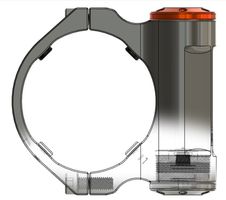
What is an inertial steering damper?
The 4K Parti Speciali inertial steering damper is based on the principle of inertial mass and the dynamics of oscillating systems.
When the handlebar undergoes angular acceleration or the motorcycle receives a longitudinal impulse (pitching), the internal mass tends to maintain its state of rest (law of inertia). This inertia generates a reaction torque that opposes rapid movement, reducing the amplitude of oscillation.
The system’s behavior is influenced by two key parameters:
Acceleration threshold
The device only intervenes noticeably beyond a certain level of stress, avoiding constant resistance on the handlebar under normal conditions.
Natural frequency of the bike-device system
The device is most effective at excitation frequencies close to its natural frequency.
A dedicated adjustment allows you to modify the dynamic response, adapting the intervention frequency to the terrain and riding discipline.
With the device installed, rapid steering oscillations and pitching movements are attenuated thanks to the reaction torque generated by the inertial mass, acting as a dynamic filter. Without the device, these stresses are fully transmitted to the rider, increasing fatigue and reducing steering precision.
MAIN ADVANTAGES
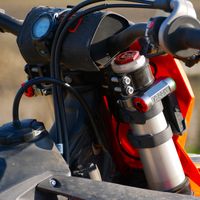
Installation
It mounts quickly and intuitively under the motorcycle’s top triple clamp using a 4mm allen key in just 10 minutes. Suitable for fork diameters from 54mm to 58mm
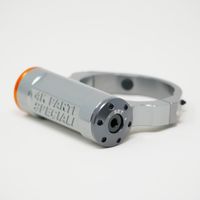
Settings
The adjustment is quick to modify and works as the main setup. It allows you to choose the system’s intervention level, adapting it to different terrain conditions and your riding style
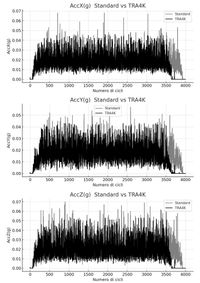
R&D Testing
The 4K Parti Speciali inertial steering damper has been refined through internal calibration developed with the aid of a 9-axis accelerometer installed on the test bike’s handlebar.
The data collected numerically translates the sensations of stability and control easily perceived during riding, allowing us to develop targeted and effective calibrations